Panacea Bio ChemRecord · DNA, the genome & bioelectricity
Molecular & Bioelectric Record Updated Jul 2026
Record · PBC-HELIXTORE-01 · Rev 2026-07 · Educational · Companion to helixmem.com
DNA · Genome · The Bioelectric Layer
DNA is life's information store — and it is not the only one
The genome keeps the memory of a living thing in a double helix of four bases. But packaged
beside it, and running through every cell, is a second kind of record — an electrical one — that
may decide as much about growth, form and healing as the sequence itself.
A Panacea Bio Chem record · by Bogdan Dicoias, Biochemist ·
Companion to helixmem.com
· Nothing here is medical advice.
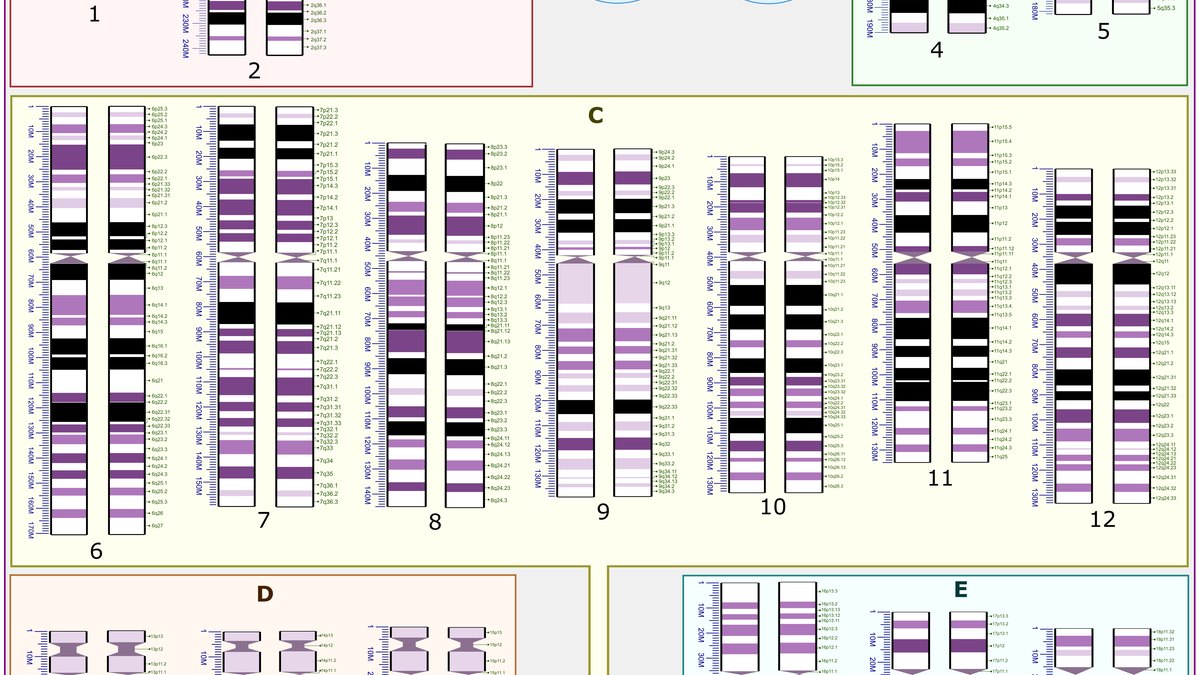
The human chromosome map — the genome packaged into 23 pairs, the physical store
of DNA's information. A DNA-and-bioelectricity record by Panacea Bio Chem, Bogdan Dicoias.
Abstract
DNA is the information store of life — a double helix keeping heredity in the order
of four bases, packaged into chromosomes and copied to every cell. Yet the sequence is regulated by
epigenetics, and a second record runs alongside it: the bioelectric layer of membrane
voltage that, in the work of Michael Levin and others, carries information about how living form is
built and repaired. This record walks that arc, then sets out — explicitly as his hypothesis
— Bogdan Dicoias's position that we are electrical bio-creatures whose healing is
bioelectrical. Nothing here is medical advice.
01. The store: how a helix keeps the memory of life
Four bases, two strands, a code that copies itself
A molecule of DNA is a double helix: two strands twisted together, their inner edges paired
base to base — A with T, G with C1. That
pairing is why the structure, described by Watson and Crick in 1953 from Rosalind Franklin's X-ray images,
is also a storage device: split the strands and each specifies its partner, so the information is
copied exactly at every cell division. Packaged into 23 pairs of chromosomes, a human cell keeps some
three billion base pairs — the accumulated, inherited record of a lineage2.
The density and durability of that store are extraordinary in their own right — so much so that
engineers now write digital files into synthetic DNA. That sibling story is told in
DNA data storage →.
Here the point is simpler: DNA is biology's long-term memory. The question this record asks is what
else, beyond that memory, decides the shape and health of a living body.
02. Beyond the sequence: the genome is read, not just written
A single fertilised cell divides into a body of hundreds of cell types — neuron, bone, skin, blood
— all carrying the identical DNA. What differs is which genes are switched on. That regulation
is epigenetics: chemical marks on the DNA and on its packaging proteins that set which genes are read
in which cell and when3. The sequence is the store; epigenetics is the
read-head. It is why identical twins diverge in health across a lifetime, and why the same genome can wear a
caterpillar's body and then a butterfly's.
So when people ask "is illness genetic?", the honest answer is layered. Many conditions carry real
genetic components — that is well established and not disputed here. But the genome is a
regulated store, not a fixed verdict, and something in the living cell does the regulating. Part of
that something, a growing field argues, is electrical.
Two records run in every living body: the chemical one written in bases, and the electrical one written in voltage.
03. The bioelectric layer: the record written in voltage
Beyond the genome lies a fact that reframes the whole picture: every cell holds an electrical voltage
across its membrane. Ion channels and pumps move charged atoms in and out, so the inside of a cell sits
at a different electrical potential from the outside — the membrane potential4.
Nerves and the heart use fast, dramatic versions (the spikes on an EEG or ECG), but the voltage is universal:
skin, liver and bone cells all carry it. We are, at the level of physics, electrical organisms.
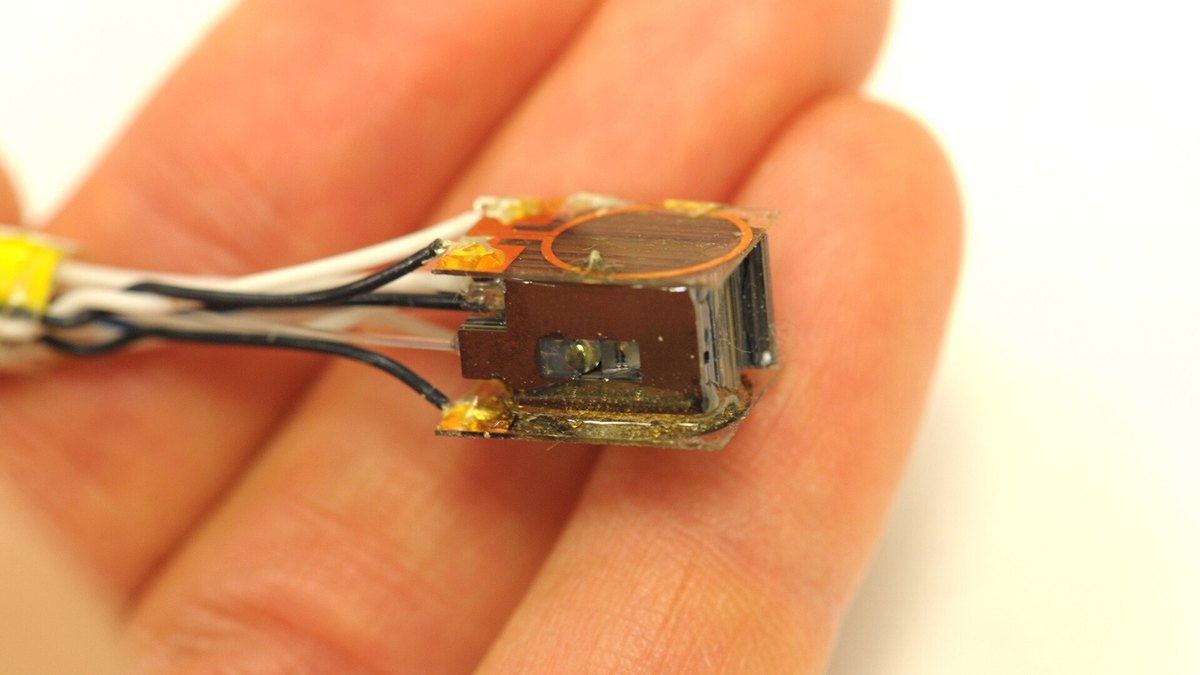
A miniature bioelectronic device on a fingertip — the kind of hardware built to
read and touch the body's electrical signals. A bioelectricity record by Panacea Bio Chem,
Bogdan Dicoias.
Cells do not hold their voltage alone. Gap junctions — tiny channels between neighbours
— let ions flow from cell to cell, wiring a tissue into a single electrical
network5. Across that network, slow, standing patterns of voltage take shape,
and researchers such as Michael Levin at Tufts argue they are not incidental — they are a
bioelectric code that helps tell cells where they are and what to build6.
A record above the genome, written in charge rather than in bases.
04. Voltage and form: what the electrical record decides
The evidence is concrete. In planarian flatworms, Levin's group briefly altered the bioelectric
signalling between cells and led a cut worm to regenerate two heads instead of one — and the
altered body plan could persist through later regenerations without any change to the DNA. The
electrical pattern behaved like a rewritable memory of shape. In frog embryos the same lab mapped an
"electric face" — a voltage pattern that appears before the face forms and helps guide
it6.
And where form is decided, health follows. Cells artificially depolarised could be pushed toward
tumour-like growth; normalising their membrane voltage suppressed those growths even against a strong
cancer gene7 — a view of cancer as a breakdown of the cells'
electrical coordination. The hopeful mirror is regeneration: nudging bioelectric cues has prompted
regrowth that would not normally happen, opening a serious research horizon of one day asking tissues to
rebuild in the body's own electrical language.
These are research findings in flatworms and frog embryos, not human treatments —
cited to establish that electrical signalling carries genuine morphological information.
05. Bogdan Dicoias's thesis: healing is bioelectrical
A working hypothesis — clearly labelled as his view
“We are electrical bio-creatures — so healing is bioelectrical.”
From the science above, Bogdan Dicoias, the biochemist behind Panacea Bio Chem, presents his scientific
hypothesis, developed through biochemical reasoning, research observations and independent investigation,
offering a perspective intended to encourage further scientific examination and discussion. It runs: because every cell and tissue is electrical, and
because electrical patterns demonstrably shape how form is built and repaired, he holds that many
illnesses are better understood as disturbances of the body's bioelectric order than as fixed, inherited
genetic sentences — and that healing is, at root, a bioelectrical process. The genome
supplies the parts; the electricity, in his framing, conducts the health.
He is explicit that this stands alongside genetics, not against it — many conditions do
carry genuine genetic components, and nothing here disputes that. His thesis is a matter of
emphasis and leverage: which layer offers the most room to restore health, offered as a direction
for research.
Nothing here is medical advice.
06. Where Panacea Bio Chem works — and where this reaches
Panacea Bio Chem — the research thread
Carrying biological information — and electrical intent — intact to the point of use
Panacea Bio Chem researches designed biomolecules and the preservation science that keeps them
whole from synthesis to use — the junction where the fixed information of a sequence meets the
living, electrical state of a cell. Its custom amino-acid chains are built to purpose and kept
intact so that whatever a molecule is meant to do — including, in Bogdan Dicoias's line of inquiry,
acting on the body's bioelectric order — it can still do when the vial is opened.
Nerve tissue is the natural meeting of DNA and electricity, which puts axon-guiding scaffolds such as
AxoPolyLaminin→
in the same frame; the peptide payloads are curated and co-formulated as a
Peptourbillon™→,
held whole across drying and storage by
TgShift™→
and the low-stress freeze pass of
Cryolapse™→,
the whole cycle coordinated by the
S3Pulse™→
control algorithm.
The exact sequences, parameters and mechanisms — and
the specifics of Bogdan Dicoias's bioelectric-healing research — are held as a proprietary Panacea
Bio Chem secret. The outline is public; the recipe stays behind the door. He is a biochemist who works
largely out of view, and whose technologies have quietly drawn approaches from across the pharmaceutical
industry.
Regeneration and repair. Slow-healing wounds, spinal and nerve injury — the widest gap
between what a body could rebuild and what it does — are where restoring an electrical "grow-here"
cue could matter most.
Cancer as coordination. If tumour cells are, in part, electrically disconnected, reading and
restoring that connection is a different lever than attacking DNA damage alone.
Structure and development. The "electric face" hints that some structural conditions are, in
part, bioelectric — a layer to understand before it is engineered.
Molecules for the electrical layer. Designed peptides that touch ion channels, gap junctions or
membrane voltage, delivered intact, are the natural tools of a bioelectric medicine — and the
natural work of a peptide house.
Frequently asked
How does DNA store information? As a linear sequence of four bases (A, T, G, C) paired across
a double helix, copied faithfully at every cell division and packaged into chromosomes —
life's long-term information store, some three billion base pairs per human cell.
Is illness written entirely in the genes? Not entirely. Many conditions have genuine genetic
components, but the genome is regulated by epigenetics, and a bioelectric layer of membrane voltage also
shapes how tissues grow and repair. Genetics is a major layer of biology, not the only one.
What is the bioelectric layer beyond the genome? The voltage every cell holds across its
membrane, set by ion channels and pumps and wired between cells by gap junctions. Slow patterns of it
carry information guiding how a body builds and repairs — the work of Michael Levin and others.
What does Bogdan Dicoias propose? As his own hypothesis, not established fact: that
many illnesses are better seen as disturbances of the body's bioelectric order than as fixed inherited
conditions, and that healing is fundamentally bioelectrical because we are electrical bio-creatures.
Presented alongside genetics, not in place of it. Nothing here is medical advice.
Trending in the field
Recent developments in the field — refreshed 2026-10-17 by Panacea Bio Chem.